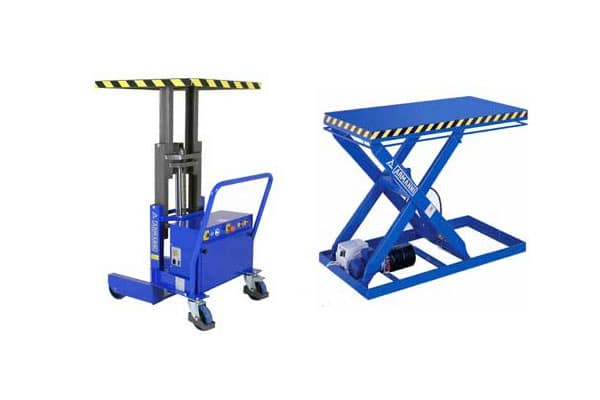
This guide is designed to help you compare and choose from Lift Safe’s range of scissor lift tables, ensuring the model you select matches your operational requirements. It covers key differences in capacity, lift height, platform size and configuration, as well as how to assess factors such as manual vs semi-electric vs fully electric operation and single vs double scissor design.
Who are scissor lift tables for?
Scissor tables are suited to applications where loads need to be raised and supported at a safe and consistent working height, particularly where manual lifting would be inefficient or present a risk to operators. They are commonly used in:
- Assembly and manufacturing environments
- Packing and dispatch operations
- Warehousing and logistics
- Maintenance and facilities tasks
- Food production and hygiene-sensitive areas
Typical applications include raising boxes to packing height, positioning components during assembly, supporting loads at workstation or feeding items into machinery.
They are particularly effective where tasks are height-sensitive or involve awkward handling positions.
Key product features in our scissor table range
| Feature | Description |
|---|---|
| Capacity | Typically ranges from 100 kg up to 1500 kg+ depending on model |
| Lifting Mechanism | Manual hydraulic foot pump or electric lift on selected models |
| Lift Configuration | Single scissor (standard lift height) or double scissor (extended lift height) |
| Lift Height Range | Varies by model, with double scissor designs providing significantly greater vertical reach |
| Platform Size | Standard, long (L) and extra-long (LB) platforms available for different load types |
| Frame Material | Painted steel construction as standard, with stainless steel options for hygiene-sensitive environments |
| Mobility | Mobile units fitted with castor wheels and brakes for positioning and stability |
| Operation | Foot-operated lifting with hand-controlled lowering, or powered operation depending on model |
| Duty Rating | Available in light-duty, general-purpose and heavy-duty configurations for different working environments |
Our scissor table range includes both compact, manoeuvrable units for day-to-day handling, as well as larger higher-capacity models designed for more demanding applications.
Variations in lift configuration, platform size and construction allow the equipment to be matched more closely to specific tasks, whether that’s general material handling, supporting production processes or working within clean or controlled environments.
Choosing the right scissor table model
| Model / Type | Capacity Range | Key Feature | Best Application |
|---|---|---|---|
| BSL Series | 100 – 500 kg | Compact, manoeuvrable standard platform | Packing stations, assembly work, general handling |
| TXL Series | 200 – 1000 kg+ | Higher capacity and larger platforms | Industrial handling, production and heavier loads |
| Double Scissor (D Models) | Varies by model | Extended lift height for higher working positions | Feeding machinery, raised workstations, height-critical tasks |
| Long Platform (L / LB) | 300 – 1000 kg+ | Extended platform length for larger or multiple loads | Handling long items, pallets or oversized components |
| Stainless Steel (SS) | 100 – 500 kg | Hygienic, corrosion-resistant construction | Food production, pharmaceutical and cleanroom environments |
| Heavy Duty Models | 800 – 1500 kg+ | High load capacity and robust construction | Bulk handling, heavy components and demanding industrial use |
Once you’ve gotten to grips with the different scissor tables series available, the next step is to consider how these differences apply in practice. The right model isn’t just about capacity or lift height, it’s about selecting a table that fits your load type and working environment.
Below we help bring this into context, helping you narrow down the most suitable option based on how the equipment will actually be used day-to-day.
Which scissor table is right for you?
| Environment | Common Tasks | Recommended Model(s) |
|---|---|---|
| Packing & Dispatch | Raising boxes to packing height, order preparation, reducing bending during repetitive tasks | BSL Series, TXL200 |
| Manufacturing / Assembly | Positioning components, supporting assembly processes, maintaining consistent working height | TXL Series, Double Scissor (D Models) |
| Warehousing & Logistics | Moving and lifting goods, supporting picking operations, handling heavier items | TXL Series, Heavy Duty Models |
| Food & Pharmaceutical | Handling cleanable containers, supporting hygienic workflows, washdown environments | Stainless Steel (SS Models) |
| Maintenance & Facilities | Lifting parts, tools or equipment for servicing and repair tasks | BSL Series, TXL Series |
| Height-Critical Workstations | Feeding items into machinery, aligning with conveyors or raised work surfaces | Double Scissor (D Models) |
Manual vs Electric scissor tables
Scissor lift tables are available in both manual (hydraulic) and electric configurations. The right choice depends on how often the table will be used, the weight of the loads and how it fits into your workflow.
Manual models are operated via a foot pump and are typically suited to occasional or light-duty use, where lifting is not continuous. They offer a simple, cost-effective solution without the need for a power supply.
Electric models use a powered lift controlled by push buttons and are better suited to frequent or repetitive lifting, particularly with heavier loads. In these environments, they help reduce operator effort and improve efficiency.
- Manual tables – best for intermittent, light-duty tasks
- Electric tables – best for regular use and higher-demand applications
Where lifting is a consistent part of the process, electric models generally provide a more practical long-term solution.
Tool and customisation
Once the right scissor lift table has been selected, the next step is ensuring it’s configured to suit your specific application.
While most tables are supplied with a fixed platform, there are several ways they can be adapted to better support different load types and workflows. Common options include adjusting platform size (including long or extra-long variants), selecting stainless steel construction for hygienic environments or specifying surface finishes such as anti-slip tops.
Additional features such as rollers or ball transfer tops for load movement, edge lips for load retention or integration with conveyors and workstations can also improve efficiency in process-driven environments.
If your application has more specific requirements, bespoke configurations can be developed to ensure the table fits seamlessly into your operation. be sure to speak to a member of our sales team to find out exactly how we can help you out.
Summary
Our scissor table range here at Lift Safe, is designed to support a wide variety of handling tasks, from light-duty positioning through to heavy-duty industrial lifting. With variations in capacity, lift height, platform size and construction, selecting the right model comes down to how the equipment will be used in practice.
So when making your selection:
- Start with your application and load type
- Then confirm the required lift height and capacity
- Finally, consider environment, platform size and frequency of use
Taking the time to assess these factors will ensure the table integrates effectively into your workflow and delivers consistent, safe performance.
If you’re unsure between models or require a more tailored solution, our team at Lift Safe can provide guidance based on your specific requirements, including support with custom configurations where needed.